She Mocked the Old Woman in a Gray Dress at Her Wedding, but What That Woman Did Next Changed Everything
You saw the scene cut off right at the worst possible moment. Here's the rest of the story, exactly as it unfolded.
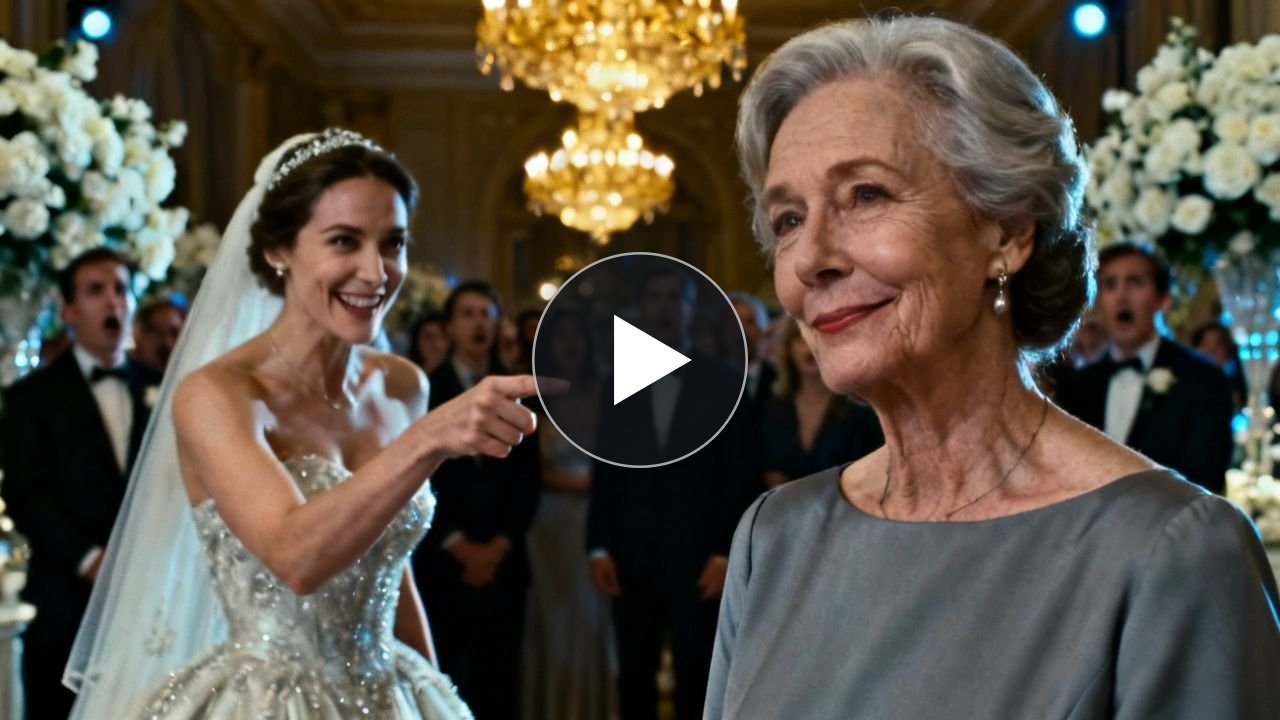
"Someone get this woman a seat in the back — she's clearly lost, and honestly, she's embarrassing us."
The words came out of Daniela's mouth like a perfectly rehearsed line, sweet enough to sound polished, venomous enough to draw blood. She had timed it for the exact moment the champagne glasses were raised, when the music dipped and three hundred pairs of eyes belonged to her.
She was a bride. The whole room was hers.
Or that's what she believed, for the last eleven seconds of her wedding day.
The woman she was talking about stood near the edge of the dance floor, holding a plain flute of sparkling water, wearing a slate-gray dress with no glitter, no ruffles, no designer label anyone could spot. She looked like someone's elderly aunt who had wandered into the wrong reception. She was seventy-one years old, silver hair pinned back with a tortoiseshell clip, and she did not flinch when every head in the Grand Hall turned toward her.
She simply set her glass down on a passing tray. And smiled.
—
To understand how a bride could humiliate a guest at her own wedding — a wedding that was, by every visible measure, a fairy tale — you need to understand Daniela Marchetti. Or better, the Daniela Marchetti that Daniela Marchetti had spent years becoming.
She was twenty-nine, a social media brand manager, and she had a vision. Not in the spiritual sense. In the precise, spreadsheet sense. She had a Pinterest board called "MARRIAGE FINAL — DO NOT EDIT." She had a color palette of champagne, blush, and antique gold. She had a seating chart that took four months to finalize.
She had, most importantly, a guest list that told a story about who she was.
The wedding was at the Grand Hall of the Villa Serrano, a historic estate on a hillside with cypress trees and travertine terraces, the kind of place where the photographs look like a magazine spread and the bill looks like a mortgage. Five hundred thousand dollars. Maybe six, with the extras. She had never told anyone the number. She had only told everyone the venue.
And standing near the edge of that travertine terrace, holding mineral water instead of champagne, was the woman paying for it.
Her name was Marguerite Vance.
—
Nobody in the room knew that. That was the point.
Marguerite was what the wedding industry would call a "silent patron," a phrase she had invented herself, because she thought "benefactor" sounded like something from a costume drama. She was a retired founder of a private philanthropic fund, the kind that quietly bankrolled scholarships, hospital wings, and — occasionally — the dreams of a young woman who had walked into her office five years earlier with a proposal written on the back of a napkin.
Daniela had been that young woman.
She had walked into Marguerite's world with a tube of lipstick in her purse and nothing else. She was trying to start a small beauty brand called Rosa Nova and she had been rejected by eleven investors in a row.
Marguerite had read Daniela's napkin proposal for two minutes. Then she had asked a single question: "What happens to the women whose faces you paint?"
Daniela had frozen. Then she'd said, "They get to be seen."
Marguerite had funded her that afternoon. Sixty thousand dollars, no paperwork, one condition. When Daniela ever made it — married, celebrated, surrounded by people who loved her — she would invite Marguerite to the celebration, and let her sit quietly in the back of the room, watching her goddaughter's dream come true.
Daniela had promised. She had meant it, back then.
—
Some promises rot slowly.
It started the year Daniela met Marcus. Marcus Hale, thirty-four, structural engineer, calm disposition, a family that owned a chain of boutique hotels across the Pacific Northwest. He was the dream that came after the dream. He made Daniela's brand go from a side hustle to a distribution deal in six states, thanks to his uncle's retail connections.
And he came with a mother named Vivian.
Vivian Hale was the kind of woman who could make a florist cry by asking about the roses twice. She had opinions about everything, including who her son married. She had approved of Daniela only after Daniela had spent eighteen months transforming herself — new teeth, new trainer, new name on the lease, new everything — into a woman who could survive a Hale family dinner.
Somewhere in those eighteen months, Marguerite stopped being a godmother and became a liability.
She was old. She was unglamorous. She bought her clothes at the estate sales of friends. She refused to be photographed. She asked questions like "Are you happy?" in a tone that sounded almost like an interrogation to someone who was, in fact, not always happy.
By the time the wedding planning began, Daniela had stopped answering Marguerite's calls.
—
But Marguerite had promised. And so had Daniela.
So the invitation went out — one of the last ones, a corner of the seating chart no one else in the family had asked about. Daniela had convinced herself that Marguerite wouldn't come. That she would send a check, or a note, or a small gift, and stay home with her books and her cat.
She saw the RSVP in her email inbox eleven days before the wedding and hadn't known what to do with her own face.
"Who is Marguerite Vance?" Marcus asked, when Daniela sat silently at the breakfast bar, holding the card like it had teeth.
"Nobody. Old woman. Benefactor. It's complicated."
"She knows about Rosa Nova? She's the one who —"
"Yes," Daniela said. "But she's from before. You don't need to worry about her."
Marcus looked at her for a second longer than she liked. He was not a stupid man. But he was a man in love, and love is a kind of anesthesia, and he let it slide.
—
The day of the wedding, the weather behaved like it had been paid.
Golden light, low wind, the kind of afternoon that makes everyone's skin look like it belongs in a perfume ad. The ceremony was at four. The vows were flawless. Daniela cried only when she had rehearsed crying. Marcus looked like a man who had won something he hadn't known he wanted. Vivian wore cream, which everyone noticed, and said nothing, which everyone noted even more.
Then came the reception.
The Grand Hall was draped in 40,000 flowers, or at least that's what the wedding coordinator told the vendors. The cake was five tiers and weighed more than the officiant. The band played a live version of a song Daniela had chosen because it had gone viral on TikTok, and the whole room stood up to watch her walk in with Marcus and a train of nine bridesmaids in blush silk.
And in the corner of the room, near a column, an old woman in a gray dress sat on a chair that had clearly been left there by mistake, watching.
Nobody had offered her a drink.
Nobody had introduced her to anyone.
She had arrived two hours early, because she always arrived two hours early, because old habits from a life of never being late were one of the few that had survived her retirement. She had watched the staff set up the lighting. She had watched the florists argue about the table runners. She had watched the caterer's van pull up to the service entrance.
She had not needed to check the invoice to know that every flower in the room had been paid for the morning of, by wire, from an account with her name on it.
She had not needed to check.
She had simply wanted to see Daniela's face on her wedding day, and she had told herself that was enough.
—
It was enough for about three hours.
Long enough for the toasts to end. Long enough for the bride and groom's first dance, which Marcus insisted on rehearsing twice, because he didn't want to step on Daniela's dress. Long enough for the father of the bride — Daniela's real father, who had walked her down the aisle and had no idea who had paid for anything — to finish his speech, which everyone applauded, because everyone in the room was there to applaud.
Marguerite applauded too.
She stood at the right moment. She clapped politely. She sat back down when everyone sat down. She was careful, because she had spent decades being careful, to take up as little space in the room as possible.
That's when Daniela saw her.
It was 9:14 in the evening. Marcus had just been pulled into a photograph with his groomsmen. Daniela was alone on the dance floor, catching her breath, and the room was warm and glowing and hers, and her eyes drifted, the way eyes do, toward the corner she had not once visited since the beginning of the night.
And there she was. Gray dress. Small glass of water. Silver hair. Tortoiseshell clip.
Watching.
Something in Daniela's stomach dropped, and something else — something colder, something that had been growing quietly inside her for two years — rose to take its place.
Why is she still here. Why is she watching me. Why does she always watch me.
—
The devil doesn't come in a red suit. Sometimes it comes in blush silk with a train of nine bridesmaids.
Daniela walked to the middle of the dance floor, lifted her glass, and called for silence. The band stopped mid-chorus. The guests turned like sunflowers.
"I want to make a toast," she said, "to the people who actually made tonight possible."
Applause. Laughter. She's so gracious. Vivian, from her table, gave a small approving nod.
"My mom. My dad. Marcus's family. My planners, my girls." She turned, slowly, in a half circle, addressing the room. "You know, I came from nothing. I built Rosa Nova from nothing. And tonight is the proof that when you work hard, when you refuse to be small — you get to have everything."
Applause again, louder. Someone whistled.
"Which is why," Daniela said, and her voice climbed, "I have to say something a little awkward."
The room held its breath.
"There's a woman here tonight who I didn't invite, exactly. She's treated this entire evening like a spectator sport. She's been sitting in the back, watching me all night like I'm some sort of exhibit." She turned, deliberately, now, to face the corner. "And honestly? If you don't belong at someone's wedding, sweetheart, you don't stand at the edge of the dance floor waiting to be noticed."
Silence. The kind of silence that follows a firework that hasn't exploded yet.
"If you're lost, ma'am — the exit is that way."
—
Marguerite stood up slowly.
Not because she was angry. She moved slowly because she was seventy-one, and because some things — dignity, for example — are performed at their own speed.
She did not look embarrassed. She looked, in fact, as if she had been expecting this. As if she had been dreading it, and rehearsed it, and prepared her face for years.
She picked up her glass of water and set it on a table. She picked up her small handbag from the seat. She straightened her dress.
And she smiled at Daniela the way you smile at a child who has just said something funny about death.
"Thank you for the clarification, Daniela," she said. Her voice was low enough that only the nearest three tables heard her. "I was told I would be welcome if I sat in the back."
"You were told wrong," Daniela said. Her voice had the high, bright, brittle tone of someone winning a game she hadn't known she was playing.
"Then I'll go."
"You should."
"Goodnight, everyone. The flowers are lovely."
And she turned and began to walk.
—
She made it four steps before she stopped.
Then she reached into her handbag and took out her phone.
The music had not resumed. Three hundred guests were watching an old woman in a gray dress stand still in the middle of a wedding she had not been asked to leave politely. Daniela was watching too, arms crossed, chin high, waiting.
Marguerite scrolled. She tapped once. Twice.
She put the phone to her ear.
"Hello, Yolanda? Marguerite." A pause. "Yes. Tonight. The Serrano event. Yes, the Hale-Marchetti wedding. Clause fourteen."
The room did not understand yet. Nobody spoke. Only Daniela's face changed — a small twitch near her left eye, the kind of thing you'd only see if you were looking for it.
"Yes, the full cancellation. Effective immediately. I'm authorizing it. Yes. And please send the standard letter to the accounts team." She paused. "No, don't wait until morning. Now."
She lowered the phone, looked at it, and said one more thing into it — quietly, so that no one else heard it, though the silence in the Grand Hall was so thick a pin could have echoed. Then she hung up.
She slid the phone back into her bag.
She looked up at Daniela.
"Goodnight," she said again. And this time — this time she walked all the way to the exit.
—
For about forty-five seconds, nothing happened.
The band looked at the wedding coordinator. The wedding coordinator looked at her phone. The guests looked at each other and did that polite half-laugh people do when they don't know how to feel.
Then the lights in the Grand Hall changed.
Not slowly. Abruptly. The warm gold of the amp drops was replaced by the hard white of emergency lighting. Above the doorway, a small red row of LEDs that nobody had noticed before began to blink.
The band's power cut. A low rumble — the kind you feel in your teeth, not your ears — moved through the floor.
Marcus, standing near the groomsmen, turned toward the sound. "What is that?"
The catering manager appeared at the edge of the dance floor, clipboard in hand, face gray. She walked straight to the wedding coordinator and said something into her ear. The coordinator's mouth opened. Then closed. Then opened again.
"What?" Daniela said. "What is it?"
The coordinator took a breath. She looked like a woman about to be fired, and she was about to be right.
"Mrs. Hale," she said. "The venue has been cancelled."
—
Daniela laughed. It was a single, sharp, ugly sound.
"Cancelled? It's a wedding. It's not a Netflix subscription."
"I'm very sorry. There's been an activation."
"Of what?"
"A cancellation clause. In the venue contract. The estate has a right of cancellation, effective immediately, if the funder requests it."
The word funder landed in the room like a rock in a quiet pond.
Vivian Hale, from her table, stood up. "What funder," she said, in a voice that could freeze a stove. "The venue was paid for by my family."
The coordinator turned to her, apologetic, miserable, entirely out of her depth. "I'm sorry, ma'am. That isn't — that isn't what our files say."
"What do your files say?"
The coordinator looked down at her clipboard as if she wished it would dissolve.
"They say the reservation was paid in full by the Vance Foundation. Eleven days ago." She swallowed. "As a wedding gift."
—
The room did not explode. The room went very, very still.
It was Vivian who broke first. She turned toward her son, who was already turning toward his bride.
"Daniela," Marcus said. His voice was level, which was worse than shouting. "Who is Marguerite Vance?"
"She's nobody."
"Daniela."
"She's nobody, Marcus, she's just — she used to help me, alright, she's some old woman who gave me money years ago and thought that meant she could — I don't know — show up and —"
"She paid for this wedding."
"She paid for a wedding. Yours, maybe. Not mine. I don't know. I didn't tell her to."
"She's the funder of record," the coordinator said quietly, still staring at her clipboard. "Every line item. The venue, the flowers, the catering, the band, the photographer, the —"
"Everything?" a bridesmaid whispered from somewhere behind Daniela.
"Everything," the coordinator said.
Someone near the front started laughing. It was a bridesmaid's date, a young man who had clearly had too much champagne and not enough sense. His date elbowed him into silence.
Daniela's face was no longer the face of a woman who had won.
It was the face of a woman who had built an evening — who had built, if she was honest, several years — on top of something she had never inspected. A foundation she had taken for granted, and then quietly decided to hide.
—
The catering staff began, quietly and with enormous professionalism, to clear the dessert trays.
The band, having lost power, began to pack their instruments by the light of their phones. The photographer — who had been shooting the whole scene because he was paid to, and who was too stunned to stop — kept his camera on Daniela's face.
Vivian Hale, in cream, sat slowly back down in her chair and did not speak again for the rest of the night. Not one word. Not to her son. Not to her husband. Not to anyone who tried.
Marcus — Marcus who had proposed on a rooftop in Portland, who had learned Daniela's coffee order by the second date, who had bought the ring the day after she had said, offhandedly, that she didn't like surprises — walked off the dance floor and out the side door into the garden and stood in front of a fountain and pressed his hands into his face.
And Daniela stood alone in the center of the room, in blush silk, in front of three hundred people, in a wedding that was not hers, in a dress that somebody else had paid for.
She had won the argument. She had made the old woman leave.
She had lost the wedding. And she knew, even before Marcus came back inside, that she might have lost much more than that.
—
Two hundred of the guests left within the hour.
The rest stayed out of loyalty, or morbid curiosity, or because their cars were blocked in the valet line. Some of them tried to talk to Daniela. She did not speak. Some of them tried to talk to Marcus. He did not speak either, though at one point he came back inside, took off his jacket, folded it over the back of a chair with the exactness of a man who needed to be doing something with his hands, and left again.
By midnight the lights were off. By 1 a.m. the tables were bare. By 2 a.m. the wedding coordinator had filed three reports, informed the insurance company, and sent a message to her team's group chat that simply said, "I'm never doing a Serrano wedding again."
By 3 a.m. the story was on social media.
Because of course it was.
Somebody's cousin had recorded Marguerite's phone call on a phone sitting quietly on a dinner plate. Somebody else had captured the exact moment the lights changed. By morning the video had traveled through wedding forums, and guru pages, and group chats of brides-to-be, and by the next afternoon it had been watched four million times.
And each time it played, another person saw what Daniela had not seen in two years.
That the woman in the gray dress had done nothing at all, at the wedding — until the bride made her.
That the bride had been the one to open the door.
That the old woman had only walked through it.
—
Here is what nobody found out until much later.
Marguerite Vance did not cancel the wedding because she was humiliated.
She was not, in fact, humiliated. She was seventy-one years old. She had been called worse things by more important people for more important reasons for five decades. She had, in the 1990s, been publicly accused of embezzlement by a journalist who later apologized in print. She had survived the deaths of a husband and a brother and a business partner and a dog she had loved more than most humans. She knew what humiliation was.
This was not humiliation. This was clarity.
She had activated clause fourteen because she had watched Daniela's face for three hours while the girl's glittering night unfolded, and she had realized — slowly, and then all at once — that the young woman who once told her "they get to be seen" had become someone who could only see herself.
She had canceled the wedding because she had decided, eleven days earlier, that she would.
Not because she was angry. Because she was honest.
She had written a letter that afternoon — a short one, two paragraphs, in her careful handwriting — and left it on the coordinator's desk in a sealed envelope, with instructions to deliver it to Daniela only if the clause was activated. Yolanda, her assistant, had hand-delivered it at 1:47 a.m.
Daniela did not open it until the following Thursday.
—
She opened it in her apartment, alone, in jeans and a hoodie, with her wedding photos still in a folder she had not yet renamed.
The letter said:
Dear Daniela,
I loved you the day you walked into my office with a napkin. I still love that version of you. I don't know where she went, and I don't think it's my job to find her. But I want you to know that I paid for tonight because I wanted to. Not because I expected anything from you except the one thing you promised me, years ago, which was to let me watch.
I watched. You were beautiful. And I saw something I wasn't sure I wanted to see.
I hope the young woman with the napkin comes back someday. If she does, my cell number is the same.
With love, Marguerite
—
Daniela cried for two hours.
Not because the wedding was canceled. The wedding was canceled, but weddings are — mostly — parties. She could have another one. She could have twelve. She could go to city hall tomorrow and be married in flip-flops and it would be a Thursday and nobody would care.
She cried because she had seen what Marguerite had seen.
She had seen herself, for a moment, at the edge of the dance floor, turning to a corner of the room to perform cruelty in front of three hundred people, in a dress she had not paid for, in a hall she had not paid for, in a life that was, in every sense, still underwritten by a woman she had decided was unworthy of being seen.
She had made a spectacle of an old woman.
The old woman had simply closed the checkbook.
—
Marcus did not leave her.
That's the part that surprised everyone, and that surprised Marcus too. He stayed in the apartment that week, sleeping in the guest room, not because he had forgiven her, exactly, but because he wanted to understand what she was when she wasn't performing. He asked her, one evening, sitting across from her at the kitchen island, whether she had ever told anyone about Marguerite. Not the money. The person.
"No," Daniela said.
"Why not?"
"Because she didn't fit."
"Fit what?"
Daniela sat with that question for a long time.
The answer, when she finally said it out loud, was quieter than anything else she had said in years. It was, if the two of them were honest, the first true thing she'd said in a long time.
"Fit the story I was telling about myself."
—
Three weeks later, Daniela took the train up to Marguerite's town.
She did not call first. She did not bring anything. She wore jeans and no makeup and a hair clip that had been in her bag since college, and she knocked on the door of a small house with a garden full of roses that were not, by any stretch, designer.
Marguerite opened the door in a cardigan and house slippers and looked at her for a long moment.
"I don't know what to say to you," Daniela said.
"Then don't say anything."
"I want to."
"Then say one thing. The right one."
Daniela stood on the porch and looked at her hands.
"I'm sorry," she said.
"Is that the one?"
"No," Daniela said, and she looked up. "The one is — I want to be the woman with the napkin again. And I don't know if I can, or if she's still in here. But I want to try."
Marguerite looked at her for a long time.
Then she stepped back and held the door open.
"Come in," she said. "The tea's already hot."
—
The wedding, when it happened — and it did happen, six months later, at city hall, with eleven guests and a lunch at a restaurant where nobody had ever heard of travertine — was small and mostly silent and mostly perfect.
Vivian Hale did not come.
She did, however, send a card.
It read, in her careful, unemotional script, I still don't like the way you handled it. But I respect the way you fixed it.
Marguerite sat in the back.
By choice.
She always did.
And this time, when Daniela stood up to give a toast, the first thing she did was turn toward the corner of the room and lift her glass, and say, in a voice loud enough for everyone to hear, "Thank you for the flowers, aunt Marguerite. They were lovely."
The old woman's eyes, hidden behind a pair of drugstore glasses, filled with tears she did not wipe away.
—
They say a wedding is the first day of a marriage.
But sometimes a wedding is not a beginning. Sometimes it is a mirror — and if you are very unlucky, or very lucky, it shows you, at exactly 9:14 in the evening, on a travertine terrace, in front of three hundred witnesses, the exact shape of the person you have become.
Daniela Marchetti saw her reflection that night.
It took her six months, one cancelled wedding, one train ride, and one cup of tea she didn't deserve to decide she didn't want to keep wearing it.
Marguerite Vance, seventy-one years old, silver hair, gray dress, tortoiseshell clip, kept her promise.
She sat in the back.
She watched the young woman she had loved come home.
Si cree que algún contenido infringe derechos de autor o propiedad intelectual, contacte en [email protected].
Copyright notice
If you believe any content infringes copyright or intellectual property rights, please contact [email protected].